Beyond the Beacon: Hacking Fresnel Optics for Visual Art
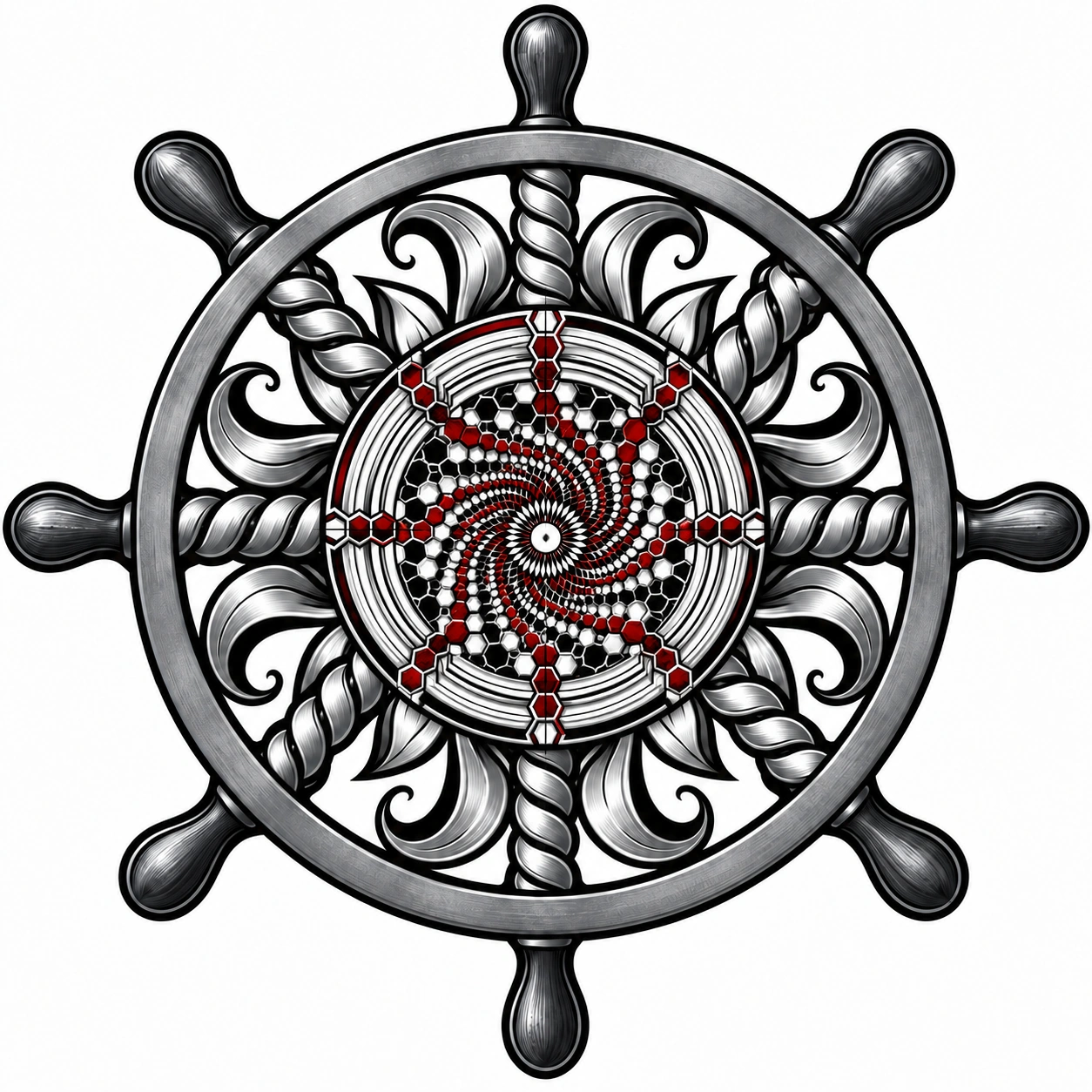
From Light to Mathematics
In the early 1820s, French physicist and engineer Augustin-Jean Fresnel revolutionized lighthouse technology by developing an ingenious arrangement of concentric glass lenses and prisms. Using the mathematics of refraction, he found a way to gather and redirect light into powerful beams capable of reaching far out to sea.
But Fresnel's contributions went well beyond the lighthouse. His mathematical investigations into the wave nature of light, diffraction, and interference revealed intricate relationships between geometry, light, and the patterns they produce.

The Umpqua Lighthouse on the Oregon coast houses an extraordinary first-order Fresnel lens, handcrafted in Paris in 1890. Standing approximately 10 feet tall and 6 feet in diameter, this two-ton optical marvel contains 616 individually cut glass prisms, precisely arranged in concentric tiers around 24 bull's-eye lens panels.
Each prism is carefully angled to refract or reflect light from a central source, concentrating it into powerful beams. Of the 24 bull's-eyes, 16 are clear and eight are red, arranged to produce the lighthouse's distinctive sequence of two white flashes followed by one red as the lens rotates.
It's fascinating how hundreds of individual pieces of glass, organized through geometry and optical principles, become something far greater than their parts—a remarkable example of mathematics transformed into light.
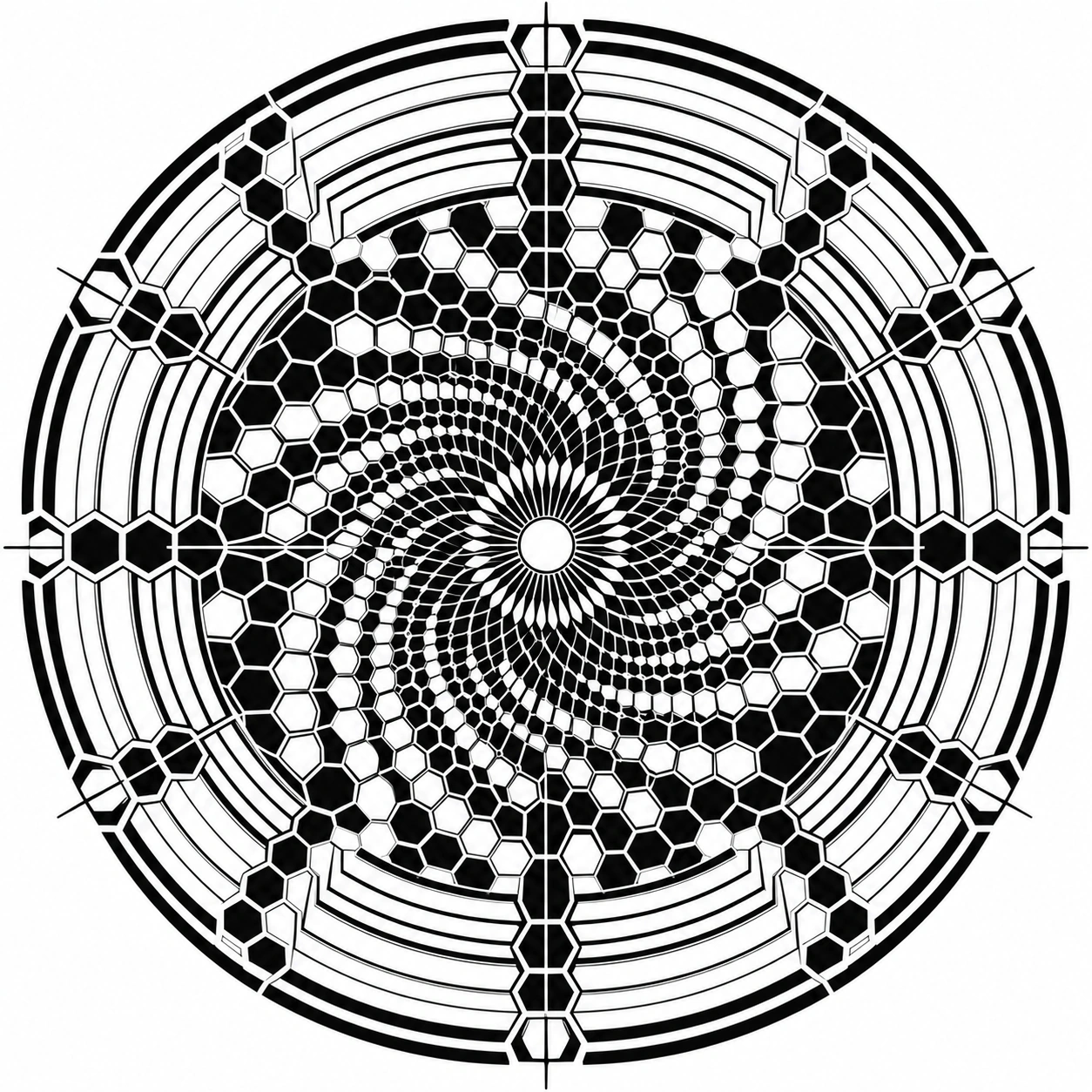
“Beyond the Beacon: The Mathematics of Possibility”
But what happens if we take these mathematical principles and attempt to apply them beyond their original intentions? Could we bend, reinterpret, or even hack them to discover unexpected patterns, optical gems, geometric structures, or new relationships to visual art or music?
A lighthouse is a beacon by design, guiding us through darkness. Perhaps the mathematics behind the light can serve as another kind of beacon—one that guides us toward creative possibilities we haven't yet imagined. The math pattern utilized for the amplified projection of light from the lens of the lighthouse creates it's own interesting pattern from the alignment of different glass shapes.
The Fresnel Spiral: Mathematics as a Creative Language
Fresnel lens geometry and the Fresnel integrals are related through his work in optics, but they're not the same mathematics. The lens primarily relies on refraction; the integrals describe aspects of wave diffraction. Exploring connections between them could lead to new frontiers in visual patterns and beyond.
Among the fascinating mathematical relationships associated with Fresnel's work are the Fresnel integrals, which can be used to trace an elegant geometric curve known as the *Cornu spiral*.
Unlike an ordinary spiral, this curve changes its curvature continuously, creating a flowing geometry that connects mathematics, light diffraction, and visual form.
What interests me is the possibility of taking these relationships beyond their scientific applications. Could variations in curvature, rotation, repetition, or opposing spirals reveal unexpected visual structures? Could these principles be adapted to artistic exploration like optical patterns that transform with light and perspective?
Rather than simply illustrating the mathematics as boundaries, I want them to be appreciated as rules that should be broken and ideas and patterns that should be altered and morphed.
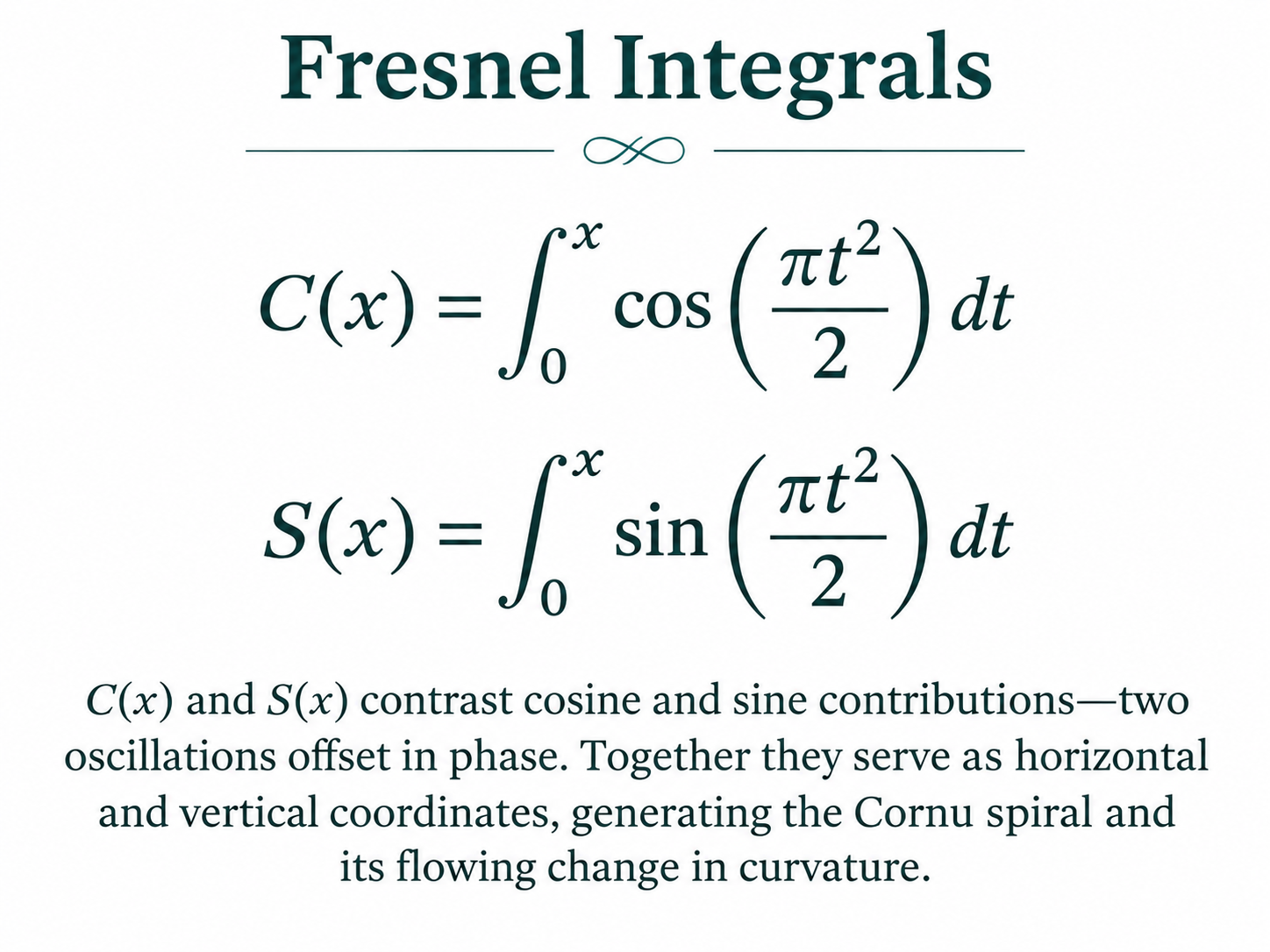
Two Equations, One Evolving Form
The Fresnel integrals introduce an intriguing relationship between two mathematical functions: sine and cosine. Both follow the same changing mathematical angle, but their oscillations are offset by 90 degrees.
One determines the horizontal movement of a point, while the other determines its vertical movement. Together, their continuously changing contributions trace the remarkable Cornu spiral.
What fascinates me is that neither equation produces the spiral independently. The geometry emerges through their relationship.
For an artist or visionary, that suggests an intriguing possibility: what new visual structures might appear if we manipulate their phase relationships, reverse their directions, rotate their coordinates, or superimpose multiple versions of the resulting curves?
Perhaps the most interesting patterns are not found within a single mathematical expression, but in the relationships between them.
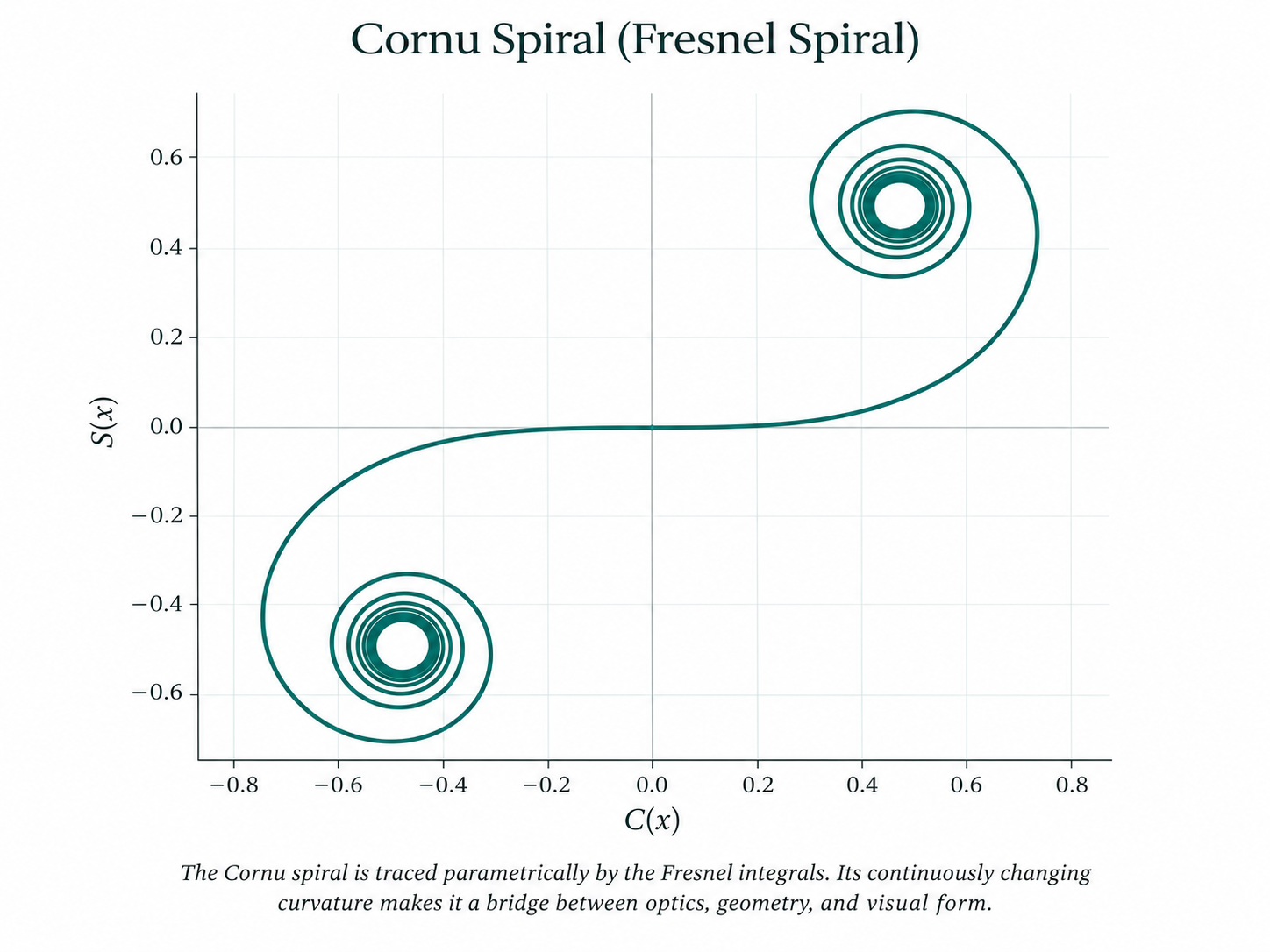
Here we see a particularly exciting connection to opposing spirals and shared boundaries.
Mathematically, we can experiment with plotting \(C(x)\) against \(S(x)\), then introducing rotations, reflections, phase offsets, and additional curves. Some transformations simply reposition the original spiral; others produce genuinely different geometries.
That gives us a rigorous starting point for exploring interference-like visual effects, layered transparent glass, reticello patterns, and optical compositions. Combining these elements with others opens it up to even more possibilities for crosstalk and discovery.

AN OPEN CONVERSATION
thoughts, questions & other perspectives...
Have an interpretation, a challenge, or an unexpected connection to share? Add it to the conversation. Thoughtful disagreement is welcome. Comments appear publicly only after the artist reviews them.
Loading the conversation…